Preamble
The idea was sparked when we attended a college fair at George Mason University Sterling University in Sterling , Scotland Scotland
Saturday, August 20, 2005
John, Chris and David began our Scotland
Our plane trip was uneventful - always a good thing in air travel. It seemed we were among the few passengers who were not sporting golf shirts, and among the even fewer who didn’t collect golf bags at baggage claim. I found this rather odd, then someone clued me in that Scotland is where the game of golf originated, and that Scotland is still a golf Mecca
Sunday, August 21 – what would a trip journal from Chris be without a description of the bathrooms?
The Glasgow
After spending what seemed like an inordinate amount of time in the rental car line (I forget now what the problem was, but we had time to make lifelong friends with the people in front of, and behind us, in line), we finally got our car - and it was a Mercedes. I guess it was worth the wait.
 |
| An interior shot of our 'Wrong Sided Mercedes'. |
So began what would prove to be one of John’s most shining achievements – driving on the wrong side of the road during our entire trip. He deserves lots of credit. Everything is opposite of what you’d expect. I liken it to an experiment I once heard about where a woman was fitted with glasses that made everything appear upside down and then was monitored to see how long it took her to get used to that new way of looking at the world. Fortunately we didn’t have to try walking on the ceiling, but driving on the left side of the road surely was an unnatural act. Even the rear view mirror is opposite from what you’d expect. And being a passenger in what is normally the driver’s seat is pretty unnerving, I can tell you! That’s where I sat through most of the trip. And on that first drive north out of Glasgow, I thought sure as shootin’ we’d scrape the left side of our car on one of the many stone walls that loomed reeealllly close to the window.
Thankfully that did not happen. As I said, many kudos to John for his driving skill - that and the many road signs posted along the Scottish highways reminding people to ‘Drive Left’.
Thankfully that did not happen. As I said, many kudos to John for his driving skill - that and the many road signs posted along the Scottish highways reminding people to ‘Drive Left’.
Here's a good example - sheepsies and all.

Our first several nights were spent at the Clachaig Inn in Glencoe, Argyll. It caters to hikers, rock climbers and the like. As such, young college types abounded. There were also the working folk from various parts of the British Isles and beyond taking a vacation in the country.
The picture above, and below are views from our room at the Inn. Some of the little white specks on the hillside are rocks and some are sheep.
![]()
The picture above, and below are views from our room at the Inn. Some of the little white specks on the hillside are rocks and some are sheep.

It rained most of the day, but somehow it seemed appropriate for it to be raining here. The rain didn’t seem to dampen the spirits of the many hikers who were staying at the Inn . Had we packed the right kind of gear, I’d have liked to join them up the slopes. As it was, we were all pretty sleepy eyed given the 8 hour change in time zones. But we did manage a short walk before dinner along a beautiful rushing stream bed that cuts through the Inn ’s property.


The Inn has a special walk-in closet type room they called the drying room. The room is kept warm, and in it were an assortment of boots, socks, leggings, mittens and other sundry soggy gear owned by said hikers and climbers. The rainy weather, it seems, is the norm there and inns such as ours have these drying rooms as a convenience for their guests.
Things we should have brought with us:
- Boots
- Gaiters
- Hooded rain jackets with Goretex shells
- Sneakers (this is NOT Paris
Several countries were represented at the inn including a nice couple from Denmark Scotland
*******************
Haggis – the National Dish of Scotland
· 1 sheep's lung (illegal in the U.S.
· 1 sheep's stomach
· 1 sheep heart
· 1 sheep liver
· 1/2 lb fresh suet (kidney leaf fat is preferred)
· 3/4 cup oatmeal (the ground type, NOT the Quaker Oats type!)
· 3 onions, finely chopped
· 1 teaspoon salt
· 1 teaspoon freshly ground pepper
· 1/2 teaspoon cayenne
· 1/2 teaspoon nutmeg
· 3/4 cup stock
Cover heart and liver with cold water. Bring to a boil, reduce heat, cover and simmer for 30 minutes. Chop heart and coarsely grate liver. Toast oatmeal in a skillet on top of the stove, stirring frequently, until golden. Combine all ingredients and mix well. Loosely pack mixture into stomach, about two-thirds full. Remember, oatmeal expands in cooking.
Press any air out of stomach and truss securely. Put into boiling water to cover. Simmer for 3 hours, uncovered, adding more water as needed to maintain water level. Prick stomach several times with a sharp needle when it begins to swell; this keeps the bag from bursting. Place on a hot platter, removing trussing strings. Serve with a spoon. Ceremoniously served with "neeps, tatties and nips" -- mashed turnips, mashed potatoes, nips of whiskey.
Haggis ready for cooking:

Haggis ready for cooking:
The finished Haggis!

********************
A Genealogical detour
John planned our trip around the Glencoe area for very personal reasons. His 8th great grandfather, John Moor, was among those murdered by the British in the famous Glencoe massacre of 13 Feb 1692. It’s quite an amazing story, really, which I will let John share with you.
John writes:
The following account is taken from Moore Moore 's in our line, is John Moor (1), born in the county of Argyll , Scotland
In 1691, The Earl of Breadalbane, head of one of the branches of the great Clan Campbell, undertook to pacify the Highlands at the moderate cost of 12,000 Pounds, a sum with which he had hoped to buy the allegiance of the most important chiefs. The government supplied him with the money, but the chiefs demanded more than the Earl had intended to give them and left him without a penny. Conspicuous among the chiefs who had ruined Breadalbane's scheme was Alexander MacDonald of Glencoe, chief of a small but warlike clan that dwelt in Glencoe, one of the wildest and most inaccessible of the West Highland glens. The clan had a long record of crimes of violence to its name and had frequently given the Clan Campbell, its nearest neighbor, good cause to remember it. In 1691, when King William issued a proclamation offering amnesty to all the chiefs and their clans who would take the oath of allegiance before 31 Dec 1691, it was only to be expected that Alexander MacDonald would refuse to commit himself until the last minute. All the chiefs except MacDonald submitted within the time. In the last days of December his fears got the better of him and he set out for Fort William , the stronghold recently rebuilt by General Mackay to overawe the Highlands . On the 31st, MacDonald appeared at Fort William
Meanwhile, Breadalbane had gone to London
The order was dispatched to Scotland Campbell
It was a deed of remarkable ferocity and treachery, though it was by no means without parallel in the blood-stained history of the Scottish Highlands. Yet, months passed before it created a stir in the Lowlands . Not until the following year did the King appoint a committee to investigate the affair. Parliament eventually declared the slaying of the MacDonalds a barbarous massacre, and, while exonerating the King from blame, asked that the offenders be punished: Dalrymple was deprived of his office; Breadalbane was sent to prison, but never brought to trial; the others escaped.
In this infamous event, John Moor (1) our progenitor, was shot dead in his garden. His wife, finding him dead, covered his body with a sheet, and fled to a malt kiln for safety. That night she gave birth to a son, the John Moor (2), who was to be among the earliest settlers of Londonderry , NH
Her husband's brother, Samuel Moor, with most of her family's relatives, had removed some time before this event, to Antrim County , Ireland Ireland
During this period of history, many families of Scottish peasantry crossed the North Channel and found homes in the larger towns on or near the coast of Ireland Ireland Ireland Ireland for America , arriving in Boston
When the news of their settlement reached Ireland , many families prepared to leave for America Ireland
The name of their ship has been lost to oblivion but an extraordinary event that occurred on passage has been preserved by tradition (for an excellent account, see Annis, 1914). Among the fairly well-to-do passengers were James Wilson and his wife who were also grantees of the new settlement in America Atlantic their vessel was captured by a band of pirates. While in their hands, Mrs. Wilson gave birth to her first child. The pirate captain evidently was captivated by the baby girl and promised that if he may name the baby, he would unbind the men and leave the ship unharmed. Mrs. Wilson agreed and the pirate named the child Mary. True to his word, the captives were released and their valuables restored. Although they stole most of their money, including $2500 of John Moor (2) (which today would be worth in excess of $100,000), the pirate captain bestowed a piece of brocaded silk of remarkable fineness of texture and beauty of design. "Let Mary wear this on her wedding day" said the pirate.
Thus the party arrived in Boston shaken, but thankful to be alive, and soon after joined their friends who had previously sailed from Ireland in 1718, in Nutfield, later Londonderry, now Derry , NH
In the year 1738 Thomas Wallace emigrated to America and settled in Londonderry, where on the 18th of December of that same year, he was married to 18-year old "Ocean Mary" Wilson
A postscript to John’s account –
Our inn in Glencoe has an engraved brass plaque affixed directly under the reception window in their lobby. It says, ‘No Hawkers or Campbells’. I’m still not sure if it was in jest - or in earnest.
Monday, August 22
Monday was a beautiful day to begin our car tour of the area. We visited the Glencoe Folk Museum in the little village of Lower Carnoch Glencoe Visitor Center , the area monument to ‘The Great War’ and the village of Glencoe
Notable items:
- Glencoe is a quaint village that includes tidy front yard flower gardens, friendly folk, a post office and a red telephone booth.
- Every town we visited in Scotland
- Every third establishment in the Scottish highlands is a B&B
- There are very few stores in the Scottish highlands. Take your own snacks.
- Because of the high price of gasoline (so high they’d think we Americans are whiney babies), people are often seen walking, carrying their groceries from the not-too-frequently-found stores.
Here follows many photos of the journey thus far.
Some shots of David and Chris in Lower Carnoch:
- Because of the high price of gasoline (so high they’d think we Americans are whiney babies), people are often seen walking, carrying their groceries from the not-too-frequently-found stores.
Here follows many photos of the journey thus far.
Some shots of David and Chris in Lower Carnoch:
 |
| Notice the car 'driving left'. |


 |
| Glencoe Folk Life Museum |

 |
The Phantom in the Tollbooth |
Pictures of the Village of Glencoe's Monument to The Great War:


Below are shots of a pretty little forested area and of a beautiful little bridge over a babbling stream in Glencoe. I loved all the flora growing out of the old stones of the bridge. |
| I felt like a Hobbit or a Woodland Elf walking through this beautiful moist mossy grove; above and below |


 |
| I think friendly trolls live under here. |

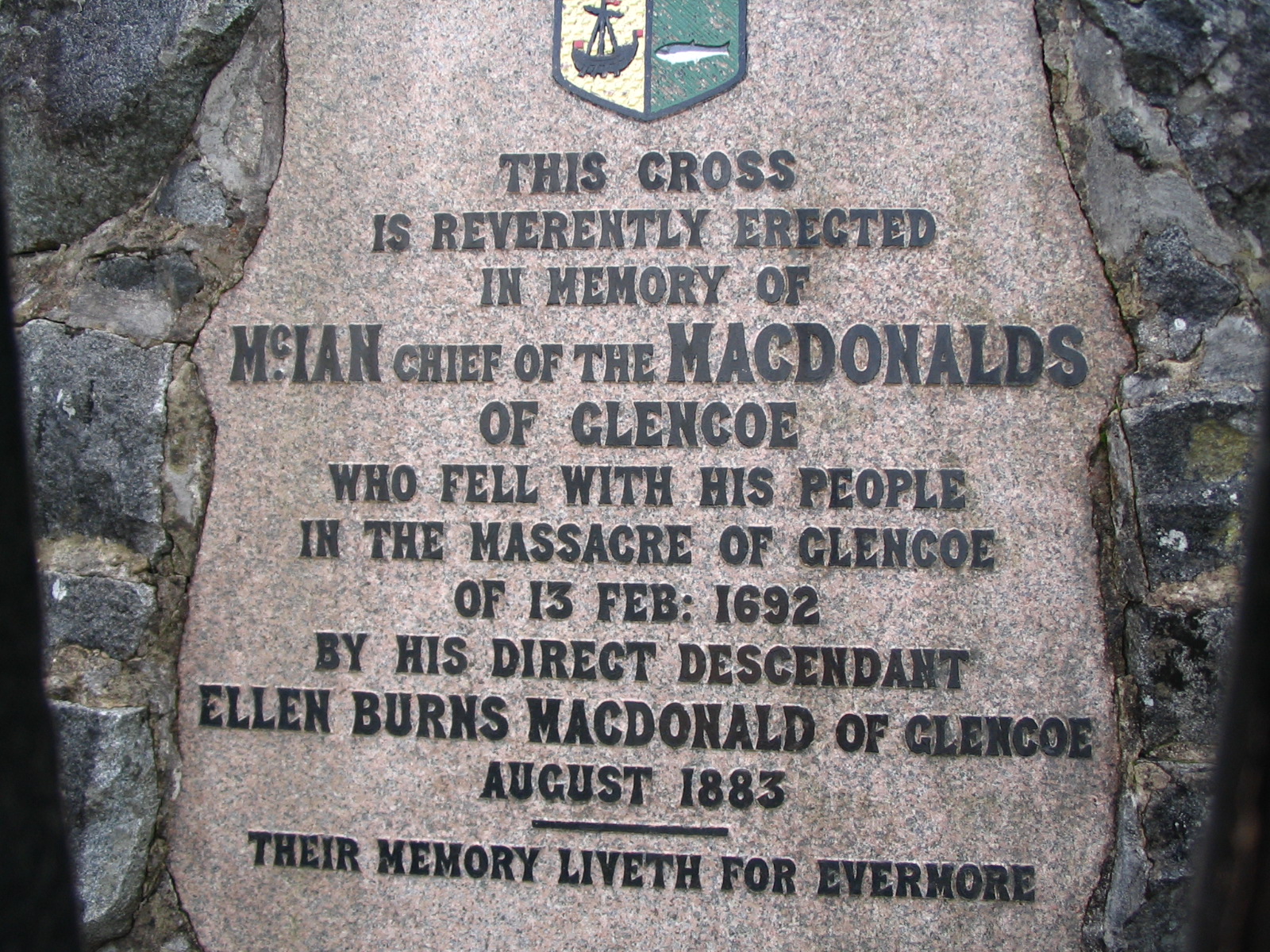
The next several pictures show the monument erected to honor those killed in the Glencoe Massacre of February 13th, 1692, among whom were John's 7th great grandfather, John Moor.



 |
| David in front of momument to the massacred who include John Moor, David's 8th great-grandfather. |
Pictures below were taken outside St. John's church in Ballachulish, outside of Glencoe:


Loch Leven outside Glencoe:


Typical of the monuments we saw in each village we drove through - dedicated to the people from that village who fell in The Great War:

Monday, continued....
We headed south toward Oban on A828, but stayed mostly on the roads less traveled, both for their scenic beauty, and for the fact that they were easier for we left-hand-side-of-the-road novices to maneuver since we rarely passed another car. Many of these roads were one lane – called single track roads in Scotland
Pictures from Castle Stalker Cafe. I wanted to go out to the castle REALLY bad! But not enough time...


We found and picked wild blackberries, ate lunch at the Castle Stalker Café near Portnacroish, and while there noted the high cost of T-shirts in Scotland
Pictures from Castle Stalker Cafe. I wanted to go out to the castle REALLY bad! But not enough time...
 |
| John walking the low tide near Castle Stalker |


 |
| Castle Stalker at low tide |
 |
| Castle Stalker at high tide |
 |
| Castle Stalker at low tide |

We discovered a small body of water that looked for all the world like a lake (a Northern lobe of Loch Crerin?). Yet when we stopped to explore it more closely, we saw it was saltwater. There were starfish, mussels and a small school of fish. The water was absolutely calm - like a still lake. It reminded me of Bras d’Or Lake in Cape Breton Island , Nova Scotia
When I say there were mussels, I mean there were ba-ZILLONS of them colonizing the tidal zone. The tide was out when we visited, so they were high and dry for us to see. There were also great quantities of beached seaweed.


 |
| John's hat to show scale of glacial grooves, striations and chatter marks found on this rock. They are from multiple episodes of glaciation. |
 |
| The light stuff that looks like stones is actually mussels |


 |
| Notice the pretty little green snail to the right of David's hand, include here to show scale. |
I found one growing on a small rock that looked like seaweed bonsai.

The single track roads we drove along wound past the beautiful fields and hills of the highlands. David was very excited when we came around one particular bend and found ourselves in close proximity (yes, John, I know close proximity is redundant, but I just like the way it sounds) to some local sheep and shaggy haired cattle. He jumped out of the car for a few photos and we all enjoyed the sense of being ‘home on the Scottish range’ so to speak.
Here, for your ooh-ing and, and aww-ing are some of the ones we visited with. Notice the free range and long grasses. Notice the beautiful countryside. How can I live there for a while?


 |
| This gives you a good sense of the wind we had that day. |
 |
| Mom and calf |
 |
| Posing for the camera |


 |
| Check out the cool ruins of the oldstone building in the background. |
We saw a lot more of the lovely stone walls. They were built with alternating layers of round and flat stones - striking. There was plenty of heather and thistle along the roads, and a beautiful orange iris like flower. We also found a terrific BBC radio station that played Gaelic music. Nirvana in a car (no, not the band, the state of mind)!
We drove on to Oban, ate dinner at the Holly Tree where we had a great view of the ocean and ate salmon, sole, an orange drink called Irn Bru (Iron Brew, I guess?) and enjoyed absolutely yummy cluty dumplings for dessert.
Clooty Dumpling – a Scottish Suet Pudding - to die for!
Clootie refers to the cloth that this fruit pudding is traditionally made in. Delicious served hot with jam and/or cream or custard. Leftovers can be fried in a wee bit of butter to re-heat. Recipes abound on the internet.

By the end of the day, our mantra had become, and remained for the duration of our stay, ‘Drive left’.
Driving tip – When you come to one of the many rotaries in the towns, and you aren’t sure exactly how to exit the darned thing into the correct lane, just keep going around in the circle until you figure it out. (And if you do so, John adds, brace yourself for unfriendly toots from the cars behind you.)
Notable Scottish road signs:
- Smoking Kills
- Slow Down Now
- Weak Bridge
- Giveway
- Blind Summit
- Flying Stones
- Flying Stones
- And, our favorite….. Elderly People
- (I’m not making this up)

 |
| Fortunately, there were no signs saying we couldn't take pictures of the livestock. |


Tuesday
Rain again.
We drove north out of Glencoe on A82 to Ft. William and shopped a bit. Again, everything was pricier than we are used to. John bought a hat. David found a smart wool cardigan. I bought a stuffed sheep toy for Daniel (Charlie wasn't even a gleam in his parents' eyes at this point).
 |
| Pretty church in downtown Fort William |
We stopped at the Loch Linnhe roadside park and walked around the loch a bit. After that, we opted to forego the distillery tour and just walk around the town some more. We had steak & ale pie for lunch. Yum!
About the weather
The weather in that area of the world has a tendency to change every few minutes. There always seemed to be a little black raincloud somewhere in the sky, below which the land was getting rained upon. The rest of the sky would be clear. Hence, one was almost guaranteed to see several rainbows throughout the day. And the rainbows weren’t the up-in-the-sky type we’re used to seeing here. These were close to the ground rainbows. It was easy to see how folks in this part of the world came up with the rainbow and leprechaun mythologies. You really did get the sense that if you went right to that spot where the rainbow touched the ground, something wonderful might be found.
Here's a nice example:

About the booze
Here's a nice example:

About the booze
Scotland is, of course, the land of single malt scotches. They abound. Almost every town boasts its own label. John is a single malt aficionado and had fun sampling the various kinds. We opted not to visit any of the distilleries, but we did purchase a few small bottles of various brands. My favorite name – and I tease John that it was named especially for him – is The Famous Grouse.
John’s favorite was the label made in his ancestral home, Glencoe. It carries a hefty 116 proof – also called ‘cask strength’. Not for the faint of heart. When John bought a bottle of it, the man at the cash register advised him, ‘You might want to add a wee drop of water to that’ in a delightful Scottish brogue.
Home of Hogwarts
It was wonderful to see familiar backdrops from the Harry Potter movies everywhere in the highlands. I half expected to see a Gryffindor flying by on their broom at any minute.


 |
| I'm not positive, but I thnk that's Hagrid's Summer home. |
Wednesday, August 24
We left Glencoe about 9:30 in the morning, heading South to Sterling
 |
| Rannoch Moor |
 |
| Looming clouds over Rannoch moor |
 |
| Rainbow over Rannoch moor |
Stopping in the pretty town of Callander
We arrived in Stirling
After our tour, we headed North and had lunch in Bridge of Allen , another quaint down near Stirling Vienna , Virginia
Here’s a recipe for Rose Water Ice Cream found on the web:
Ingredients
· 275 ml whole milk
· 4 large egg yolks
· 110 g superfine sugar
Directions
1. Heat the milk slowly in a pan to boiling point.
2. Meanwhile in a bowl, beat the egg yolks and sugar together until smooth and foamy; pour the heated milk over the egg mixture, beating all the time.
3. Return the mixture to the pan and cook over a low heat, stirring constantly with a wooden spoon, until it thickens slightly to form a coating over the back of the spoon (do not let it boil).
4. Pour into a bowl, cool then refrigerate until chilled, stir in the cream and rosewater then either churn in an ice-cream maker or pour into a shallow plastic box and place in the freezer until completely frozen (after 2 hours of freezing, you may wish to remove the ice cream from the freezer and whisk it to remove any ice crystals that form at the edges – repeat this twice more during the freezing process).
5. 30 minutes before serving, place the ice cream in the fridge to soften.
After Bridge of Allen
We stopped for drinks at the Lion and Unicorn Pub which had a sign on the door that read ‘Locals Bar – Beware of the Regulars’. One of those regulars left the pub at the same time we did, and recognizing us as Americans, asked us something about (I’m paraphrasing this) how we could, in good conscience, have elected George W. Bush for president. When we told him that only half of the Americans who voted, voted for Bush, he seemed genuinely surprised. Regardless of your political feelings, what struck me was that he seemed to assume all Americans were of one mind. Interesting, eh? In this day and age….
We spent that night in a B&B called Hillview Cottage. They had excellent Scottish porridge for breakfast. The walls were of stone and close to 3 feet thick! Window wells were set deep into the walls. I wonder what the history of the place is.
What most Scottish bathrooms have that Americans need:
- On-demand hot water showers (ie, no water heating tanks)
- Towel warmers
Thursday, August 25
The Rob Roy museum in Callander was our first stop. It was quite an interesting place with a semi-interactive life sized diorama of life in the area many moons ago.
![]()
![]()
![]()
After the museum visit, we made the very pretty drive North toInverness , mostly going along Highway 28.
One wonderful aspect is that there was no sign of suburbia along the whole stretch. There was not one new housing development. I could live here.

 |
| Note the stylish Scottish jumper and cap |


After the museum visit, we made the very pretty drive North to
One wonderful aspect is that there was no sign of suburbia along the whole stretch. There was not one new housing development. I could live here.
John notes, there are no large grocery stores, no hardware stores, no billboards and the TV had very few commercials. They do not seem to be consumption focused people – not unlike his Scottish father, Harold Moore. Again, I could live here.
 |
| Pretty waterfall along the road from Stirling to Inverness |
We checked in at the Pine Guest House in Inverness and it was the nicest so far - a beautiful old building with much charm and coziness. After checking in, we strolled the walkway along the beautiful River Ness which runs through the city. There were stately old trees, ducks and footbridges. David decided he wanted to live there. Alas that there was no university in Inverness .



 |
| River Ness; above and below |

 |
| The Old High Church |
 |
| Across the River Ness you see the Old High Church on left and the Free North Church on right |
 |
| the Ness Bank Church |
 |
| Inverness street scene; above and below |


 |
| Cathedral Church of St. Andrew; above and next 4 below |


 |
| Inverness Castle; above and below |

 |
| Inverness war memorial; above and below |

 |
| John at Inverness war memorial |
 |
| Grounds around Inverness war memorial; above and next two below |


 |
| Possible tidal bore on River Ness |
 |
| No caption needed. : - ) |

 |
| These were much larger than life cigarette packs - maybe 4 feet tall - with very blunt messages |
 |
| A couple of shots of my future home in Inverness |

Many buildings in Inverness had an interesting array of chimneys that we couldn’t quite figure out. Each building had several small ones poking out of their roofs.
![]()
![]()


Strathy Point!
The single track road that led directly to Strathy Point was wonderful. At the head of the final walk to the point we parked our car at what looked like the driveway of a small lonely farm that sported goats and a friendly little grey kitty cat.


Back to the Point








 |
| I think these have a particularly artistic look to them. |
Friday, August 26
We breakfasted on sausages, eggs and toast that morning. Seems the Scots like their toast cool vs. we Americans who like it hot out of the toaster. And their sausages are larger, paler and blander than the links we are used to in America
Chris felt the urge to feel the full force of the North Atlantic slap her in the face before leaving Scotland North Atlantic winds at Strathy Point, then I don’t know what.
We set out north from Inverness on Highway A9 crossing the bridge over Beauly and Moray Firths to begin what would be a loop drive around the North East highlands area. Shortly after that we crossed the Cromarty Firth bridge, followed soon afterward by the Dornoch Firth bridge (Where is Jane when we’re having so much fun?)
When we reached the town of Golspie
 |
| Golspie Harbor at low tide. Notice boat sitting on the bottom awaiting the incoming tide. |
 |
| David and Chris walk down to the water |
 |
| Golspie Pier |
 |
| Goslpie Pier above and below |

 |
| Pretty Golspie harbor home above and below |

 |
| Pebbly rivulette coming into the harbor |
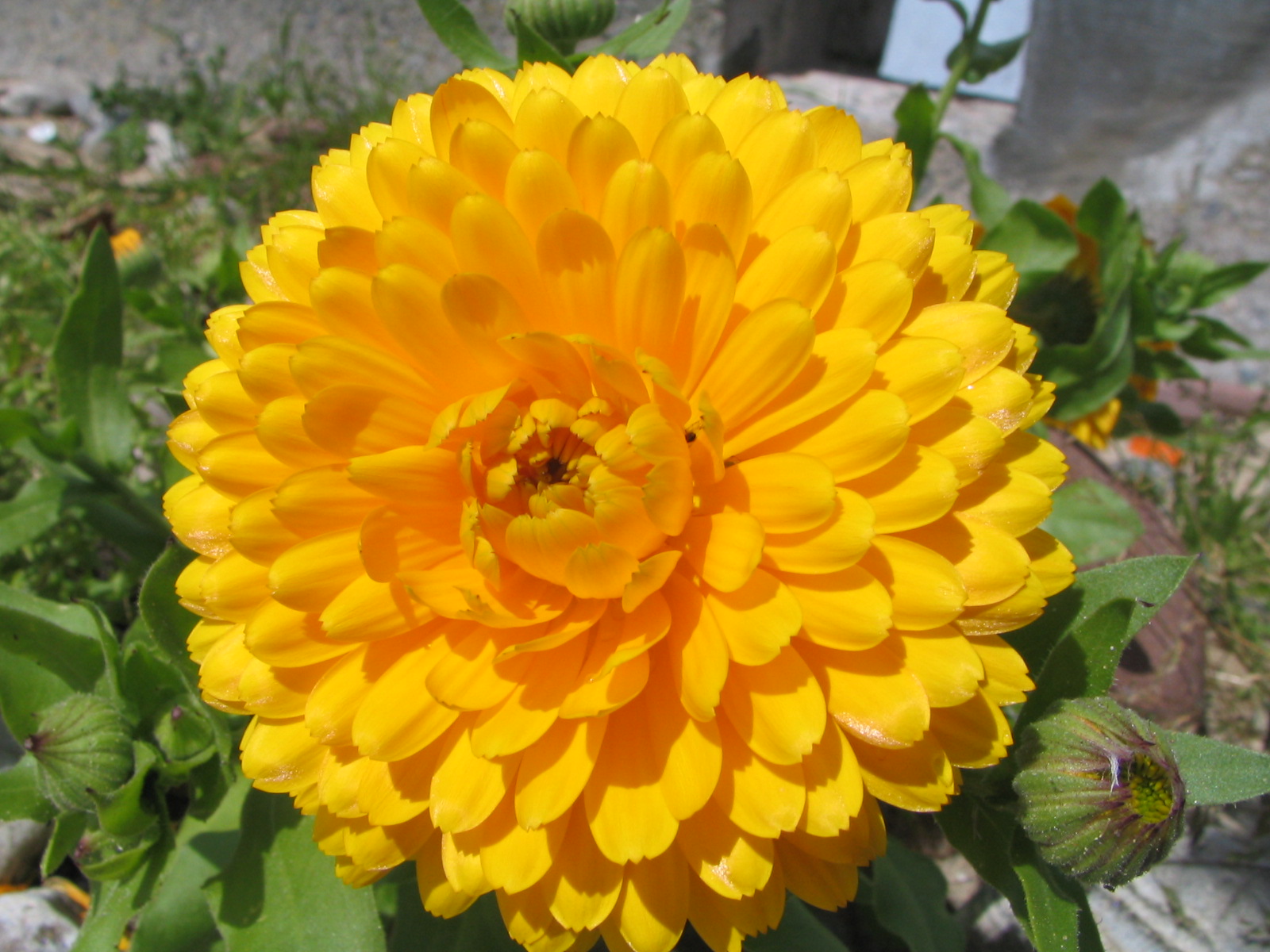 |
| Beautiful dahlia above and below |

 |
| John by what I think is a breakwater; above and below |

 |
| Peek-a-boo! |
 |
| Rose hips along the harbor walk |
 |
| A pretty and charming walkway in Golspie |
 |
| Garden hedge along harbor |
 |
| Thistle gone to seed |
After Golspie we stopped in Helmsdale to take pictures of an engaging monument called The Emigrants.
 |
| A picturesque bridge in Helmsdale |
 |
| The Emigrants monument; above and below |

The single track road that led directly to Strathy Point was wonderful. At the head of the final walk to the point we parked our car at what looked like the driveway of a small lonely farm that sported goats and a friendly little grey kitty cat.
 |
| Chris and David on the final path to Strathy Point |
 |
| He spoke with such a heavy brogue we could hardly understand him. |
 |
| Reaching for that greener grass on the other side of the fence. |
Rewind back to the drive to the Point...
All in all it was a beautiful drive to Strathy Point with an abundance of heather and purple loosestrife along the roadsides as well as wildlife sightings. The river waters were crystal blue which, against the backdrop of the purple heather, made a most picturesque view.
Below, and a bit out of sequence, since this was before we actually got to the path to the point, are pictures from our drive to the point.
 |
| David and Chris exploring a beautiful heathered river bank |
 |
| Craggy heather rock garden along the roadsides; above and below |

 |
| Beatuful heather; above and below |

 |
| Daisies along the riverbank |
 |
| Sylvan riversides |
 |
| Heathered hilltops in the distance |
 |
| Roadside meadow diners; above and below |

 |
| 'Thistle do', he decided |
 |
| How pretty would it be to ride this train? |
 |
| Highland Hart; above and below |

 |
| Rocky river reminiscent of VT and NH; above and below. You can often see that Scotland was once a part of the same land mass. |

There were many sheep grazing on either side of the Point approach path, and they didn’t seem in the least perturbed by either the high winds or the frothy little sea foam blobs - created by the fomenting waves crashing at the bottom of the cliffs - that rained down on the hillsides like snow, and coated the ground for as far as 100 feet from the sea! And of course, the ever present rainbows.


 |
| Chris and David and the Strathy Point approach path; above and below |
 |
| Chris seems to need a sock adjustment |
 |
| David on Strathy Point path |

 |
| Cottony blobs of sea foam that lands on the hillsides; above and below |

 |
| Contented sheep aren't bothered by the North Atlantic extremes; above and below |

Well, Chris wanted to experience a full frontal assault of the North Atlantic winds, and she got her wish! And she loved it! (I won’t say it does much for hair-dos, however.) It’s a good thing the wind was blowing inland as we were standing there. Otherwise, I fear we’d have been blown right over the cliff!.

 |
| Chris has that Elvis hair thing goin' on |
 |
| Gimme a peanut butter and banana sandwich |
 |
| Meanwhile, David's hair stays in place |
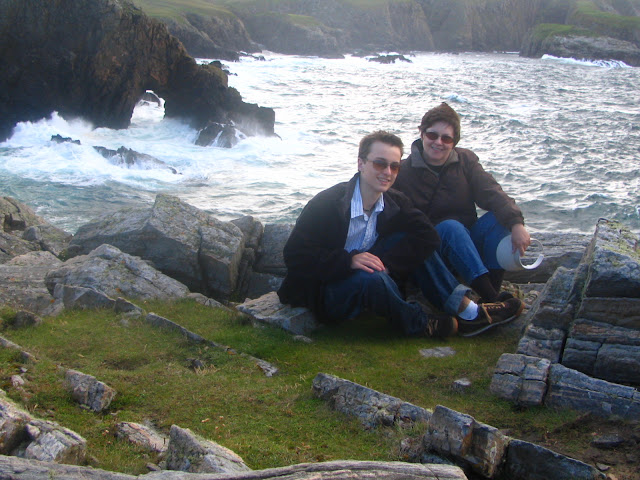
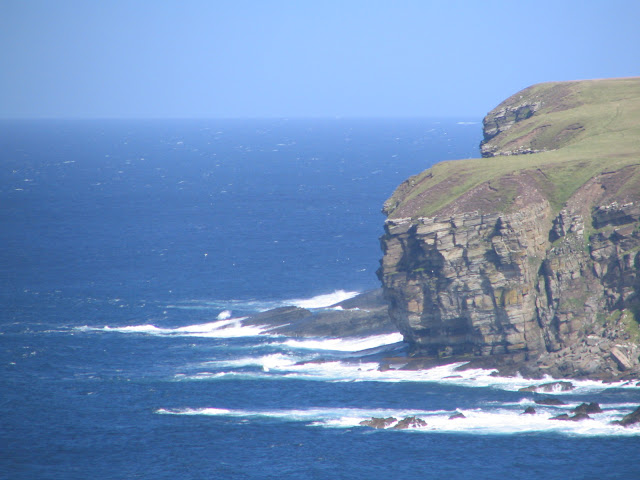
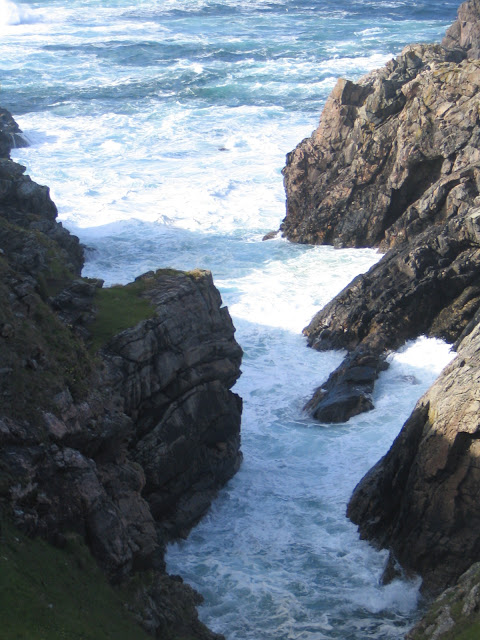
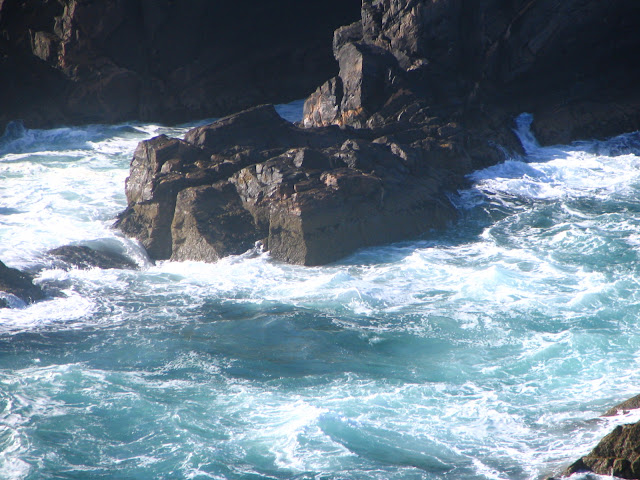
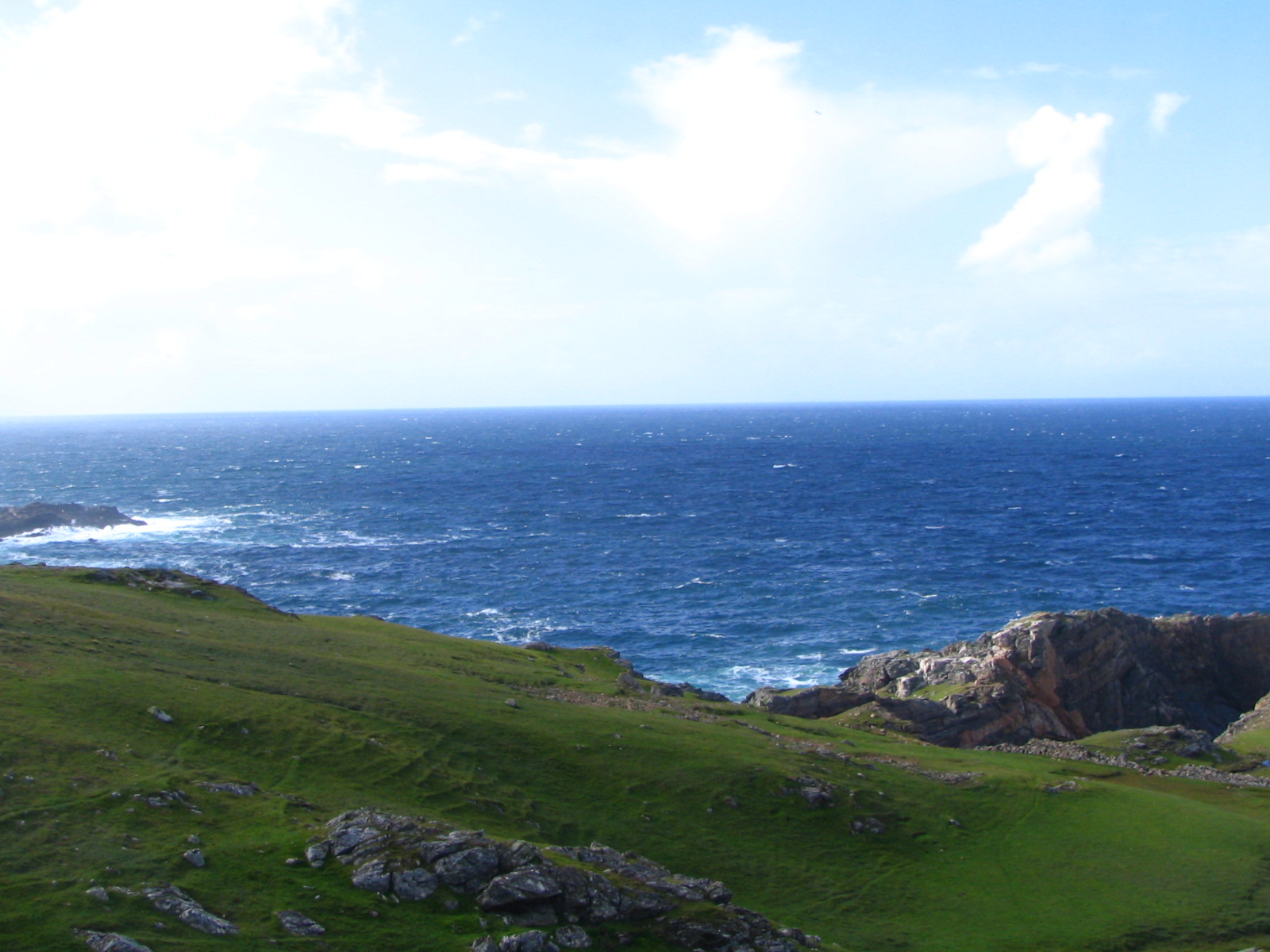
Strathy Point is a wonderful place to experience the raw power of a natural crashing thundering shoreline. THE SURF IS SO LOUD YOU HAVE TO SHOUT TO BE HEARD! You hear a constant boom as each wave crashes into the cliff walls below you. There is a rock arch that has been formed over the millennia by the constant pounding of the waves, and that created a special – if a bit eerie – sound all its own as each wave crashed through.
Between the whipping wind, the constant, rhythmic crashing of the waves, the faint bleating of the sheep on the hillsides and the soft sea foam raining down on us as the wind carried it up from the water below, it was simply a fabulous experience.
Here are some of the bazillion pictures we took. I only wish we could have captured the sound also.




 |
| Notice the rock wall at the base of the hill |


 |
| For scale, notice the sea birds on the rocks |


 |
| Double double, toil and trouble, Fire burn and cauldron bubble. |


 |
| This picture and the remaining ones show the arch through which the sea waves thundered and crashed. |


We bid a fond farewell to Strathy Point and headed back to Inverness by way of highway A836 and had dinner at a pub in the village of Ardgay Inverness in the dark, after our fish and chips supper, we saw no less than 20 rabbits along the roadsides. Coneys, I believe they call them in the U.K.
Saturday, August 27
Why procrastination is not a good thing:
The rest of our trip has fallen victim to the sands of time, so to speak – meaning that none of us can remember much about it any more. Such is the risk of waiting 6 years to put it all down in writing.
We left Inverness headed back to Glasgow Scotland , one wonders why Ness gets all the glory.
 |
| Ruins of Castle Urquhart on Loch Ness |
Where we spent the night Saturday night is a memory lost to us, but we weren’t on the street, so it must have been somewhere adequate for our needs.
Sunday, August 28
We arrived at the airport around 9:00 a.m. – why do I recall that detail after 6 years? Because I remember that every adult in the airport gate area was sitting there happily sipping on a pint, and I thought, ‘Wow, now that’s a sight you don’t see in the states – all these normal people sitting around at 9:00 in the morning happily sipping on a pint.’
So, when in Rome
The flight back must have been uneventful, because we don’t recall any of it. Except for…..
Remember the jacket?
During our layover in Philadelphia we went back to the TGI Fridays with hopes, but no expectation, of picking up John’s leather jacket that he’d left on the back of his chair when we ate there a week prior on our way to Scotland. But our faith in humanity was burnished when, low and behold, they had the jacket safely ensconced in the managers office, awaiting our return. How ‘bout that?